Religion
The New Catholic Answer Bible
- What is Apologetics?
- Does the Church Teach Evolution?
- Why is Catholic Worship Full of Rituals?
- What is the Holy Trinity?
- Aren't Statues a Form of Idolatry?
- Why Won't the Church Ordain Women?
- Why Are Abortion and Embryonic Stem Cell Research Wrong?
At the same time, no matter how terrible the evil caused by sin, God is great enough, and wise enough, to bring about through that evil an even greater good (see Gn 50:20, Rom 8:28).The first reference is what Joseph says to his brothers when they come to Egypt to get grain, while the second is the famous "All things work out for good for those who love God." Although these references do speak of God bringing good out of evil, it was not obvious to me that it was an "even greater good" than the one God would have brought about had the evil not taken place. In another place, insert K-3 (about divorce) refers to Mt. 19:9, which contains the (in)famous "exceptive clause." Unfortunately, the RNAB has a unique rendering of this exception as "unless the marriage is unlawful," which is an interpretation or commentary; the actual text literally reads "except for unchastity." I am uncomfortable with the tract treating this gloss as though it were really what the Bible says. It may work with someone who only uses this Bible version, but what happens when he encounters a different version, or a Protestant calls him on it? I consider these quibbles and overall, Thigpen and Armstrong have done an excellent job of explaining the Church's teaching on a variety of topics simply and accurately.
This book includes RNAB Bible text and reference aids, plus 88 pages of inserts for a total of 2008 pages.
The New Catholic Quiz: First Grade
This book provides 200 questions (50 each in four different categories based on the four sections of the Catechism of the Catholic Church - Beliefs, Sacraments, Morality and Prayer) to help children reinforce basic points of Catholic doctrine. Each page has a question from each category with answers on the back of the page. The color-coding makes for easy reading and checking of answers. My children really enjoyed the sometimes humorous choices for the multiple-choice questions. I thought these made the Quiz more engaging and helped them be more memorable for children. Quiz questions can be answered informally or in a game format where scores are kept. My children enjoyed this quiz book very much.
Sample questions from this book: (page one)
Belief: God created the universe and everything in it. True or false?
When a man and a woman get married they ________.
(a. promise to love each other always, b. promise to drive the same car, c. promise to buy a house together)Why is life holy?
(a. because it is short, b. because God let us do anything we want, c. because God, whog ives life, is holy)Who leads our prayers at Mass?
(a. the priest, b. the server, c. the lector)
Imprimatur
Later update: The "The New Catholic Quiz" (or simply "Catholic Quiz") series which this book is from seems to have been out-of-print and difficult to find for a long time.
The New Catholic Quiz: Second Grade
Based on the Catechism of the Catholic Church. See description in the review for the First Grade set.
Sample questions from this book (page one)
God the Father, the Son and the Holy Spirit are called ________.
(a. the Communion of Saints, b. the Most Holy Trinity, c. the Beatitudes)The Eucharist helps us to ___________.
(a. dream, b. think. c. love)Jesus teaches that forgiving others is better than revenge. True or false?
Prayer is more like _________.
(a. running away, b. looking for fun, c. thirsting for water)
Imprimatur
Later update: The "The New Catholic Quiz" (or simply "Catholic Quiz") series which this book is from seems to have been out-of-print and difficult to find for a long time.
The New Saint Joseph Baltimore Catechism No.1
Though very inexpensive, the New Saint Joseph Baltimore Catechisms with explanations written by Father Kelley are worth their weight in gold. They are based on the Baltimore Catechism which was first approved by the Archbishop of Baltimore, James Cardinal Gibbons in 1885. The New Saint Joseph version goes beyond the simple question-and-answer format of the original catechism, it incorporates Holy Scripture with each lesson and includes discussion questions, a fill-in-the-blank section, and suggested Bible readings at the end of each lesson. The pictures themselves are a great teaching tool, as they illustrate spiritual truths.
Memorizing the questions and answers of the catechism provides the opportunity to build a religious foundation. This basic Catholic doctrinal foundation gives children the tools necessary to defend their faith when they are old enough to apply reason and logic, much like memorizing the alphabet before learning to read and analyze literature.
In addition to memorization of the question and answers, I copy the accompanying Scripture onto a 3 by 5 index card. Then the children and I memorize the Scripture verse and discuss how it applies to the week's lesson. I am careful to emphasize the Scripture as a part of a whole picture rather than putting too much emphasis on individual verses. We review the Q&A and Scripture each day for a week, before moving on to the next lesson. Book no. 1 has the Baltimore questions and answers divided into three parts: The Creed, The Commandments, and The Sacraments and Prayer. Its recommended use is for grades three through five.
This book is available from nearly all Catholic homeschool providers.
The One-Minute Apologist
The Orphans Find a Home
This is the story of three orphan immigrants – Maria, an Italian in her early teens, Molly, a little Irish girl with a way of getting into trouble, and Ming, a very shy Chinese girl. Maria, Molly and Ming, survive for a time by sticking together and living in a dark boiler room until their lives are changed by meeting Mother Cabrini. The author, who is a Catholic homeschooling mother, has included questions and other study helps in the areas of history, geography, vocabulary and religion. The author has also produced a sewing kit for making a Mother Cabrini habit (complete with cross and rosary) for "American Girl"-type dolls and related craft and activity books which are available from the publisher.
The Parables of Jesus
In a similar manner to The Miracles of Jesus, Tomie de Paola presents seventeen of Jesus' parables. This book makes them very accessible to small children and may even be the start of some interesting little discussions with your children about why Jesus told these stories. Some of the text of the parables is very brief.
Available in both hard and softcover editions
The Passion of the Christ
This is a powerful film; it made me weep, and turn away, and flinch. During much of the movie I was thinking, "I'm sorry, Lord, I'm sorry". My husband and I walked out of the theater barely able to speak, feeling raw and emotionally exhausted. It was absolutely the most intense movie I've ever seen, and every time I began to think, "It's only a movie", I also heard, "He really went through this."
For the most part, the story is just as we know it from the Bible and the Stations of the Cross (including a touching scene with Jesus and Veronica). Our Lady is portrayed beautifully, as a loving Mother to Jesus. Her love and faith are evident throughout. The affection of the apostles for Mary is also evident; Peter calls her "Mother" in one heartbreaking scene after the denial. Flashbacks during the horrific scourging bring blessed relief as we see peaceful moments in His life, including a scene from His childhood, a playful moment with Mary, the Last Supper, and more.
Mel Gibson has taken poetic license with certain elements of the story, but those things only made the larger Truth of the story even more compelling. For example, his portrayal of Satan is absolutely chilling, and while I couldn't say that the images he uses are necessarily Biblical (though some are), they are appropriate. The movie leaves no doubt about the supernatural element of the battle between good and evil. There is a great deal of literary symbolism, especially regarding eyes, and there is a running theme of Truth ("I am the Way, the Truth, and the Life", and a discussion of "Veritas" that Pilate has with his wife.)
As a work of art, it is superb. It is expertly directed, the cinematography is stunning, and the original soundtrack is hauntingly beautiful. I have only minor quibbles with a few things (for example, some of the costuming). Others have pointed out problems with the historicity of the languages used, or the length of hair of the characters. In no way, however, do these small things compromise the effect of the film overall.
Many have complained of possible anti-Semitism. Yes, some of the Jews come off very badly in the film; so do virtually all of the Romans. This film is no more anti-Semitic than it is anti-Italian. It is a story set in a particular place with particular ethnic groups. Jesus was a Jew; some of the Jews loved Him, others wanted Him dead. As Christians, we know that all of us are sinners; we all are responsible for the death of Christ.
One warning: I would not take young teens, and certainly not younger children, to see this movie. The sadistic cruelty displayed by the Roman soldiers would destroy the innocence of children who do not yet know the full extent of evil in the world, and the graphic, bloody scenes would be too shocking for them. Should any teens see it? Yes, older teens, if they are mature, and well-grounded in their Faith.
In spite of the violence and brutality pictured so vividly in the movie, the images that linger are the beautiful ones; His compassion, His strength, and above all His Love. This movie is certainly not entertainment. Instead, it is an opportunity for prayerful reflection on the sorrowful passion of our Savior and Redeemer, and His infinite Love and Mercy.
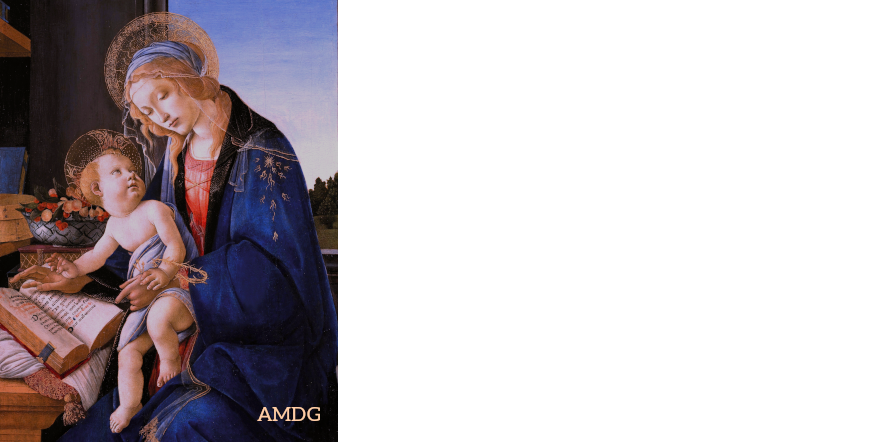
Rated R, 126 minutes
Director: Mel Gibson
Cast: James Caviezel, Monica Belluci, et al.
The Passion of the Christ (additional review)
My husband and I finally went to see the Passion just last night (Monday of Holy Week). It was a very powerful and thought-provoking movie. There are a few things in particular that I think make it stand out from other movies I've seen about the Life of Christ.
The role of Mary in the story: The thing that struck me most about the Passion is how strong Mary's role is in the story. Rather than a minor character that flits in and out of the story (as occurs in many of these type of movies) this movie is quite Mariocentric. Many of the most moving scenes involve Mary's interaction with her Son. The movie also illuminates the Blessed Mother's role in Redemption, contrasts her role with that of the devil, and helps develop our own relationship with her and her son through her interaction with the Apostles of Jesus. It is difficult to put into words how powerful her role in this movie is. It is certainly worth seeing even if only for this alone.
The way Jesus is portrayed: While a lot of press has been given to the graphic nature of the portrayal of Jesus in this story, the uniqueness of his characterization goes well beyond this. Jesus is portrayed as having a very natural balance of strength and gentleness and appears as very strong and "manly". Flashbacks of Jesus talking to His followers and interacting with His mother particularly highlight this and provide contrast to the drama of His extreme torture. The portrayal of the brutality of Jesus' tormentors is quite graphic and hard to watch. I think it is beneficial, however, in many ways - particularly for modern viewers accustomed to movies with a lot of gore and violence.
Other Catholic symbolism: There was a great deal of beautiful symbolism which I have rarely seen in other movies of a similar nature. The most striking, to me, was the sacredness of the Precious Blood spilt during the scourging and highlighted by Our Lady and Mary Magdalene lovingly wiping it up with linens. There are also strong themes relating to the Eucharist and repentance. The whole movie can make for a great examination of conscience (I believe this is actually aided by the original language and subtitles because it has such a different feel from other movies) and would be excellent to watching during Holy Week.
The Question of Children watching the Passion: While watching the movie, I did focus on whether it would be appropriate for my eldest daughter to watch (she's almost 11). My husband and I agreed that it would be better for her to wait. Not only the graphic nature of Jesus' torture, but also some of the details involving the devil and the children tormenting Judas might be both troubling and confusing to her. We plan on purchasing the movie when it comes out on DVD and letting our children see it a little at a time where we can discuss it and focus on areas most appropriate to their age and maturity levels. Because of the the Passion movie, we have recently bought Jesus of Nazareth and the Robe, which I believe will be helpful at their particular stages. (Even the four and six years olds seem to be getting quite a bit out of these two movies - particularly when we discuss them at the dinner table or when the children chat about them together.) I do know a number of pre-teens and young teenagers who have seen the Passion and were glad they saw it. I think parents need to decide on an individual basis who the movie would be appropriate for. For my part, I think the movie is intended for adults but probably would be managable for most teens 14 or 15 years and older.
Rated R, 126 minutes
Director: Mel Gibson
Cast: James Caviezel, Monica Belluci, et al.


