
FOR PARENTS, GRAND PARENTS, GODPARENTS, SISTERS, BROTHERS, UNCLES, OR AUNTS WHO FOR SOME REASON FIND THIS BOOK IN YOUR HANDS
These stories were written to disarm rather than alarm. They are meant to show that the saints were not marshmallows - pale, sticky- sweet glops of goo that could be interesting only when toasted. They are meant to show human and lovable (most of the time) people whose passion for God led them into preposterous escapades.
Their lives are as unbelievable, as fantastic, as fairy tales of princesses with golden hair, princes on white stallions, blacker-than-hell witches, elves, pookahs, black ravens, white rabbits and smoke-belching dragons.
Fairy tales clear the way for sanctity. They are the child's first morality play, clear-cut, no-nonsense black and white, good and evil, life and death - with a bit of fun thrown in to alleviate the pain. The lives of the saints, so filled with derring-do, gaiety, charm and courage, are all the more fantastic because the persons were real, even though they might seem right out of the pages of Hans Christian Andersen.
You will not find dates and statistics here, except where they seem necessary to explain how or why a saint got to his particular spot.. And I have used the embroidery of legend because I feel that under its eye-catching trivia, there is the good homespun of fact. Sometimes it has been hard to discover which facts are the real facts. In reading six books about one saint, you may have as many versions of his or her death - he may have died on the battlefield, in the arms of a wife or son, pinned to a tree with seven arrows. ..or a combination of all three.
I have chosen lesser-known saints because these are the ones to whom I am drawn, coaxing these hideaway saints out of the dusty pages of old reference books for one brief, if fanciful, moment in the sun.
When you see a statue of a saint in church or a painting in a museum looking very long-faced and sour, please don't think saints were that way when they lived on earth. Most of them were very much like us. They laughed and cried and enjoyed picnics and ice cream and hopscotch, told jokes and had quick tempers. They probably pinched their baby brothers and were spanked for it when they were little. They might even have stolen apples from the store and lied about it. Certainly they hid their liver under their plates at suppertime.
But then something happened. God spoke to them, and they stopped what they were doing and listened, and every thing was different from then on. They took their ordinary lives and made them into extraordinary adventures.
No matter who they were (farmers or soldiers or queens or jugglers), they knew where they were going. They made butter, washed lepers, sailed to Nova Scotia, taught children the alphabet, or whatever God gave them to do, as perfectly as possible. They knew that God was always with them so nothing could frighten them - not even thunderstorms, spiders or death.
They loved this world as well as Heaven. The birds and beasts and everything God had made were their friends. They tried to see Christ in all people, even those who were a pain, a bore, or just plain nasty. It wasn't easy, but they knew God loved them, so they tried.
The saints teach us one important thing-that we don't have to follow anyone else's way to holiness. All we have to do is want to be saints, in our own way and using our special gifts, and God will send that gift of grace with each sunrise. That grace will help you master the bumps in the day ahead.
If you want to be a saint badly (or goodly) enough, then you will, and someone a few hundred years from now may be writing a story about you!
Alice
Once upon a time in the country of Burgundy, there lived a princess named Alice. When she was two years old, her father, King Rudolf, said to King Hugh of Italy, "Hugh, I think your son, Lothair, is a handsome, smart fellow. He should be just right for my daughter in about fourteen years. What do you say to an engagement?"
Hugh thought that was a fine idea, so the two kings signed a paper saying that Alice and Lothair were to be wed. Everyone celebrated at a great feast, with Sparkling Burgundy for the grown-ups and raspberry ice cream for the children.
When Alice was sixteen; she became queen of Italy. She would have been very happy except for Lothair's brother, Berengarius. He was as dark and evil as Lothair was bright and good. He was very jealous of his brother and his bride, for he wanted the throne for himself.
The young couple ruled Italy justly and kindly for three years, and then Lothair died. (Some say his brother poisoned him.) Berengarius tried to persuade Alice to marry his son. When she refused (she didn't even like his son), the angry brother imprisoned her in his castle on Lake Garda.
Alice felt as if the world had come to an end. After years of being 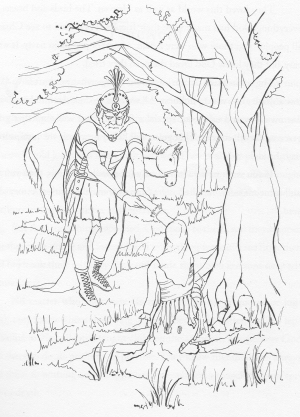 loved and treated royally, here she was in a bleak castle dungeon, in a rough itchy dress that didn't fit, and her beautiful hair no longer hung with ribbons and jewels but cut blunt and uneven. She was glad she had no mirror to see it. "This is no way for a queen to be treated," she sniffled. She was alone, abandoned, friendless. It even hurt to cry, because her nose was already red and sore from a cold brought on by the dampness.
Then God spoke to her, quietly so as not to startle her. "Be of good heart, Alice. Don't you know I will rescue you at just the right moment? Dry your eyes and open your ears - listen."
All Alice could hear was the scurrying of hard-shelled black bugs, up and down the walls, to and fro, hither and thither, across the floor and under the door. But above this came the sound of tap-tap-tapping. It came from the grate of the window set high above her.
She stepped carefully over the bugs and looked up to see an old priest who had been her friend when she lived in the palace. He had not , forgotten his queen and had come with a plan to rescue her. First, he would dig a tunnel from outside where he was, to under the cell where she was. Then he would come up under one of the stones on the floor, which Alice would have to loosen.
It sounded impossible to Alice, but she remembered that nothing was impossible if God was helping. She prayed that the priest wouldn't get caught and that the black bugs wouldn't eat her toes while she was waiting. In a few days there was a thumping and knocking under the very stone she was kneeling on. She pried it loose, and there was the face of her friend, the priest. Come quickly, he whispered, follow me, and pull the stone down after you." She did as she was told, just as the guard came to see about those strange noises in the queen's cell. The stone moved slightly, and his eye caught it.
"Oh no, you don't! Come back here this moment, Your Majesty, you're not allowed to escape! Excuse me, Your Majesty, but you better watch out because I'm coming down after you!"
And he jumped down the hole after them. But they had scrambled through the tunnel so easily, they were through and out in no time flat.
The priest bid Alice goodbye, for he had to be back to his rectory for dinner so his housekeeper wouldn't suspect anything. Alice thanked him and began to make her way through the dark, unfamiliar wood. Suddenly she began sinking in the mud. It came up to her ankles, then her knees, and she felt as if she were stuck in a glob of cold, thick molasses. When it got to her waist, she cried out to her guardian angel to get her out of this mess.
The sound of galloping horses drew nearer and nearer, and just as the mud reached Alice's armpits, a band of soldiers in strange uniforms appeared. The leader jumped off his horse and, standing on the firm, rocky soil, he reached over and pulled her to safety.
He told Alice he was Otto, the Emperor of Germany, and he had come to Italy to defeat the evil Berengarius. "Good!" said Alice.
When he accomplished this, Alice no longer had to hide. She was free. Otto, who had fallen in love with her when he first saw her in the mud, asked her to marry him and to become the Empress of Germany. Alice thought this would be lovely, for she had fallen in love with him when he pulled her out of the mud, and so they were wed on Christmas Day. The German people loved Alice and called her "a marvel of grace and beauty." She was indeed a marvel, for in her lifetime she would be princess, queen, empress, wife, and (after Otto died) nun.
Everything that happened in her life, Alice handled with grace. Nevertheless, she still would shudder whenever she heard the sound of . those black, hard-shelled bugs scurrying around in the dark.*
* Alice is also known as Adelaide or Adelheid.
Excerpted from Once Upon a Time Saints by Ethel Pochocki Copyright 1977/1978/1996, Used with permission of Bethlehem Books