No name
Founders of Freedom
This first volume in the Catholic American history program, Land of Our Lady, is intended for the fourth grade. It overviews history from Creation to just before Columbus' voyage in 1492. The focus is mostly on Western History – Europe and the Middle East – but Ancient China is also touched upon. Emphasis is placed on the origins of democracy and people in history who were instrumental in its development in various forms (as a preparation for the study of American History – this year's text develops the "background"). The text is very Catholic with a great deal of attention given to Saints who had a role in history and the Catholic Church's influence on civilization. Also included between each Unit are a Marian hymn (with a black and white illustration of Our Lady) and the history of the hymn. While some more controversial issues such as the Inquisition aren't covered (which is reasonable for a 4th grade text), I was happy to see the author point out some of the good and bad of events such as the Crusades. This balanced presentation of history is more helpful for students who have to prepare themselves to defend their Faith in the future.
The text is readable and interesting (although do keep in mind that I LOVE history), but still rather textbookish. Because it is an overview, many topics are covered rather briefly and the "stories" of history aren't present. There are a rather large quantity of written problems, activities and other reviews designed to reinforce the ideas in the text. I would be inclined to only use some of the written problems and instead supplement with some "living books" (stories from History), such as those listed on our Timeline of Good History Reading.
I did notice a few small errors (as is common in textbooks).
First, the term Oro et Laboro which means literally means "I pray and I work", is interpreted as "To work is to pray" which I think is not only a mistranslation, but a misunderstanding of the rule of St. Benedict.
Second, on page 205, a photo of Neuschwanstein Castle (from Germany),which was built in the 1800s, is labeled "a medieval castle". (No, I'm not an expert on castles – our family put together a 1000piece puzzle of this castle last year!).
Some brief references to the Latin Mass (as a universal institution) and Communism are slightly outdated. Overall, I thought it to be quite a good text and I'm looking forward to reading the next volume.
This book was donated for review by Neumann Press
The Lord of the Rings
The Lord of the Rings: The Fellowship of the Ring (Movie)
Overall, Tolkien fans (who are considered rather "fussy") seem to be rather pleased with the movie, and with good reason. Although it's very difficult to turn such a complex and imaginative story into a movie, and the movie will certainly never replace the book, overall I think the movie-makers did a fantastic job. First, and most importantly, I think they captured the overall themes (the temptation of power, the reality of evil, etc.) very well. The characters are very well-cast and quite believable. As might be expected in a movie version, the plot is simplified, several characters are compressed into one, etc. The neat thing is that significant portions of dialogue are taken directly from the book and the essentials of the plot are really quite faithful to the original story. My husband and I (who have both read the books) enjoyed the movie very much. Since we were expecting the birth of a child at the time and she decided to arrive significantly past her due date, we were able to see the movie twice in the theater, which is a real rarity for us.
For those unfamiliar with the books, this first part of three books introduces us to the main characters in the story - Hobbits - and the other races of Middle Earth - dwarves, elves, men and wizards. We see the beauty of the hobbits' homeland - the Shire - and their simplicity and love of nature. We are introduced to Bilbo who discovered "the Ring" and prepares to leave it to his nephew Frodo. When Gandalf discovers the true identity of the ring - the One Ring that was forged by the evil Lord Sauron to control all living things - Frodo sets out to bring the ring to a safer place and thus begins his quest.
This movie is not intended for young children. The story is very complex and focuses on major conflicts between good and evil. Turning it into a movie without making it silly and laughable creates rather intense cinema. Happily the moviemakers sought a PG-13 rather than an R rating and thus there is almost no blood and gore and no bad language or other objectionable content. The movie does, of course, portray battle and action scenes and a number of rather frightening creatures that some young children find too scary even when reading the book. It is sometimes easier to allow younger children to watch this sort of movie when it is released to video/DVD where the entire effect is less intense and scenes may be edited at will.
Although I think that watching the movie will lead many people to pick up the book, I think it best to read the book before seeing the movie so that one's first impressions in the imagination come directly from the book rather than another's re-creation of it. Parents, in particular, might do well to read the book before seeing the movie because, particularly if they aren't regular movie-goers, I think the violence and intensity wouldn't make much sense without being familiar with the plot and themes.The extended version of the movie, which was released to video and DVD in November 2002, is really worth seeing. It incorporates 30 minutes of additional footage into the movie which helps make the story more understandable and enjoyable, but made the movie too long for the theatrical release.
Rated PG-13 (Violence)
The Lord of the Rings: The Two Towers (Movie)
Two of the toughest characters to portray - Gollum and Treebeard - were absolutely amazing. Gollum is a complex character - tortured by his desire for the ring, whom you don't know whether to hate or pity. A computer graphics generated character, he was entirely believable and pathetic in the way, I think, Tolkien intended him to be imagined. Treebeard could so easily have been a silly cartoonish character. While not without humor, he's also magnificent and ...respectable in the way that one would appreciate and admire an older gentleman who's a bit eccentric.
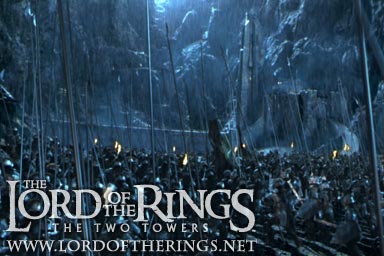
There are several general things that I think remarkable about this phenomenal task of creating movies from Tolkien's beloved stories. (For those who really like movies, as my husband and I do, the Fellowship of the Ring DVD is interesting partly because of the extensive commentaries, interviews, photo galleries, etc. which provide details on both how the movies were made and what the movie-makers were trying to do.) Many of the people most intimately involved in the movie production have read the story countless times. Faithfulness to Tolkien was a major priority for them. They have referred to the books over and over again, not just in writing the screenplay, but in how the actors portray their parts. A great deal of attention and thought has gone into many, many details of the story. For example, recordings exist of Tolkien himself reading parts of his stories. Ian McKellan, who plays Gandalf, based his portrayal of Gandalf, in voice tone and expression, on these recordings. Christopher Lee, who plays Saruman, has read the books every year for decades. In addition to his excellent portrayal of the villain, he discussed parts of the book with the other actors to be sure that certain details weren't left out. The two artists most famous for illustrating editions of the Lord of the Rings, Alan Lee and John Howe, worked as art consultants on the sets and miniatures. Peter Jackson, the director, collaborated with hundreds of cast members, production members and Tolkien fans to fine tune the script and the ideas. We had a local news story here in Wisconsin about a man who was, as a hobby, an expert in Tolkien's fictional languages. He offered his services to Peter Jackson and was invited to play a part in the production. I've never heard of any project done in this kind of fashion and the final result is truly reflective of the incredible effort and labor of love that went into making these movies.Jackson and crew did a great job of balancing this rather dark, middle part of the story with some enjoyable comic relief (especially found in the character of Gimli the dwarf) which flowed quite well. I thought there were a few more unnecessary plot-deviations than in the first movie (particularly a significant thread involving Aragorn), but this annoyance was rather minor. We enjoyed the movie very much and look forward to its conclusion, The Lord of the Rings: Return of the King, coming out in December 2003.
Rated PG-13 (Violence)
The Mitchells: Five for Victory
This is a charming and thoughtful story of an American family of five children during World War II (based on Hilda Van Stockum's own family) whose father is away at war. The family is very real with plenty of worries and troubles...but they manage to find joy with each other. For independent reading, it could be one your children's first full-length chapter books.Wit and wisdom make it a can't miss for adults as well (a perfect read-aloud). This has been a favorite with our family (for children as young as four or five) for many years.
Washington D.C. is an exciting place to grow up and the children are enchanted with pets, clubs and a mysterious girl who has just moved in down the street. Mother's attempts to take in boarders and a visit from Uncle Jim and "Mr. Jenkins" keep them busy while Father is away. Pets and babies are particularly memorable characters.
There is an aspect of the story that might be troubling for young children sensitive about adoption. A neighbor who considers adopting a war refugee decides not to because the child doesn't get along with the lady's son. The fate of adopted children is discussed rather carelessly by this lady (in terms of "well, my son has to come first") and the mother of the Mitchells doesn't have any good comebacks to resolve the issue. The story resolves nicely, however, as the girl ends up finding her grandfather, but this segment might need a little explanation. My sister-in-law (who has two adopted children) found the issue troubling and put the book aside until her children were older.
Canadian Summer
Canadian Summer continues the story of the Mitchell Family (this is the second book in the series) several years after World War II. Baby Catherine has joined the family. Father is back from the war and has moved to Quebec for his job. He has difficulty finding housing for the family, but finally makes arrangements and sends Mother, Granny and the children up on the train. Upon arriving, the ladies are shocked to find that accomodations consist of a remote ski cabin lacking electricity or running water. Doctors and stores are many miles away and transportation is nearly impossible. Wild animals and a big lake worry Mother, but intrigue the children. Of course they discover the pleasures and difficulties of rural life and have many interesting and humorous adventures.
Hilda Van Stockum is a gifted storyteller whose motherly (and grandmotherly) experience is evident in all of her books. The little details and stories, so grounded in the truth and reality of large loving families, are just plain wonderful. These books are highly recommended.
Friendly Gables
Friendly Gables is the final book in the Mitchell's Series and our favorite of the bunch.The family has recently settled into a large, comfortable house in Quebec. Mother has just given birth to twins and a cranky nurse comes to help. The children are adjusting to life in Canada – including French schools and a boy who's itching to pick a fight with "Yankee" boys.
Six-year old Timmy has my children in fits of laughter every time they hear about the toothache in his tummy and his exclaims of "Good News!" They are enchanted by the Mitchell's story-telling games, their secret-hideaway in the attic and their twin baby brothers. There are of course many humorous adventures and many wonderful tidbits about family life. Despite frustrations and set-backs, in the end they see that kindness is the best policy.
This is the kind of story that we pick up when we're having a bad day, read a chapter or two aloud, and feel much better afterwards.
The Sally Series
Bernadette, Our Lady's Little Servant
In the consistent style of the Vision Series of non-fiction Catholic stories for young people, the author presents a very engaging account of the important story of Our Lady's appearances to Bernadette Soubirous – probably the poorest and simplest child in the small town of Lourdes, France. Bernadette's beautiful devotion is inspiring and her stubborn honesty is refreshing. More important, however, is Our Lady's message and her profound effect on those who come to her out of devotion and sometimes only curiosity. Many people who have visited the famous spring at Lourdes have experienced miraculous cures, but there are many more miracles that can be seen only within the human heart.


